Glue and Tape for Party Crafts: What Sticks to What
A plain guide to the adhesives used in handmade party decorations: which glue or tape suits paper, cardstock, tissue, felt and cardboard, and how to stop joints warping or popping open.
Tutorial at a glance
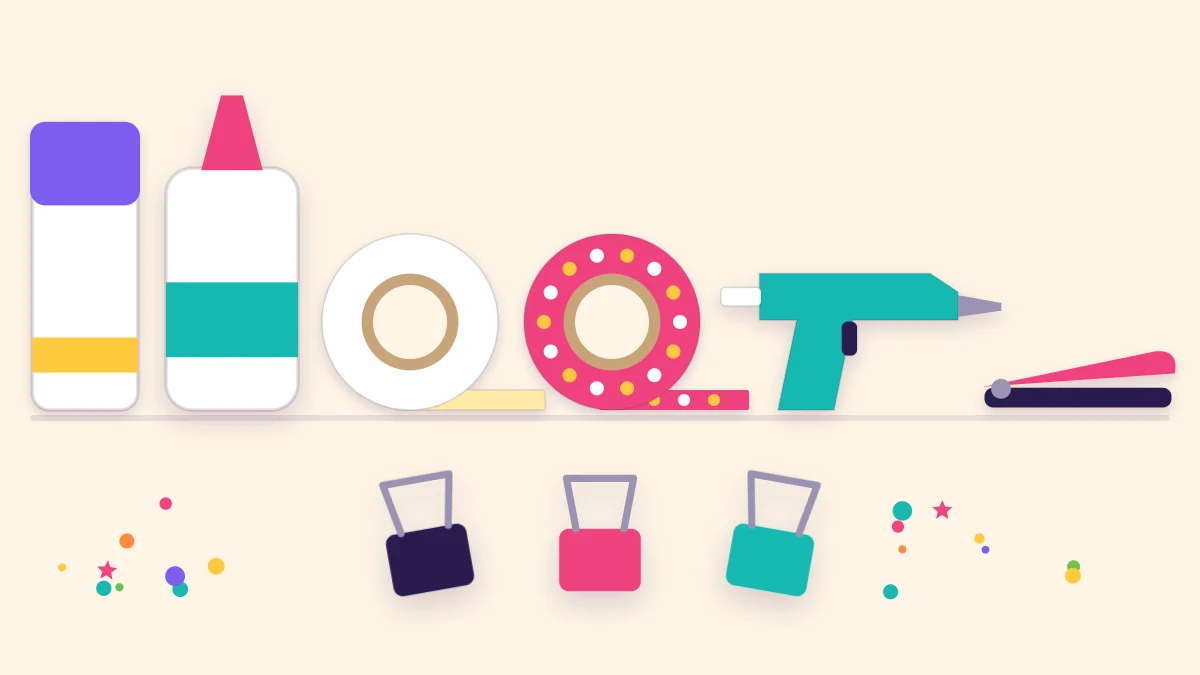
Materials
- Glue stick
- White liquid craft glue
- Tacky glue
- Double-sided tape
- Clear tape and paper tape
- Hot glue (adult use)
- Fabric glue for felt
- Stapler and staples
Choosing glue and tape for party crafts comes down to two questions: what are the two surfaces made of, and how much weight or spring does the joint have to resist? A glue stick that holds a paper dot on a cupcake topper perfectly will let go of a rolled cone hat within minutes, because the curved cardstock is constantly trying to flatten itself.
Most decorations that fall apart on the day were made with the wrong adhesive rather than a bad one. A small kit of four or five generic adhesives covers nearly every birthday project, and knowing which one suits which pair of materials saves a lot of re-gluing.
The adhesives worth keeping in the box
None of these need to be a particular make. The plain versions sold for school and office use do the job.
- Glue stick. Best for flat paper on flat paper. It stays movable for a few seconds, so layers can be nudged into line, and it adds almost no moisture. It is weak on heavy, curved or springy pieces.
- White liquid craft glue. Much stronger once dry, but wet. Thin paper ripples if the glue goes on thickly.
- Tacky glue. A thicker liquid glue that grabs sooner and sags less. Good for cardstock structures, felt and small trims.
- Double-sided tape. Instant, clean and flat. Ideal wherever a seam has to hold the moment it closes.
- Clear tape and washi-style paper tape. Visible, quick and mostly temporary. Paper tape can be part of the design.
- Hot glue. Fast and strong on cardboard, felt, dowels and thick folded paper. It is an adult tool.
- Fabric glue. Stays flexible, which suits felt pieces that will be bent and stored.
- Staples. A hidden mechanical fastener for places a layer of paper will cover.
What sticks to what
Use this table as a starting point, then test on a scrap of the same paper before committing a whole batch.
| Joining | Best choice | Also works | Avoid |
|---|---|---|---|
| Paper or cardstock layers, flat | Glue stick | Double-sided tape | Thick liquid glue |
| Cardstock seams under tension (cones, boxes) | Double-sided tape | Tacky glue with clips | Glue stick |
| Tissue paper to cardstock | A light swipe of glue stick | Narrow double-sided tape | Liquid glue |
| Felt to felt or to cord | Tacky glue or fabric glue | Hot glue | Glue stick |
| Corrugated cardboard to cardboard or dowels | Hot glue | Tacky glue with a weight | Glue stick, thin tape |
| Paper to a straw or pick | Tape plus a dot of tacky glue | Hot glue | Glue stick alone |

Glue stick and liquid glue: where each one fails
A glue stick fails by letting go. Run it right to the edges of the smaller piece, press from the center outward, and expect it to hold layers such as the circles on a topper or the letters on a pennant. Do not ask it to hold a tab on a box.
Liquid glue fails by warping. The water in it swells the paper fibers on one side, and the sheet curls as it dries. To prevent that, squeeze out a small puddle on scrap, spread a thin film with a scrap of card or a cotton swab, join the pieces, and press them under a heavy book for about ten minutes.
Tacky glue behaves the same way but with less water, which is why it is the better pick for cardstock tabs and for the cord on a felt birthday garland.
Tape: the fastest clean joint
Double-sided tape is the answer whenever a piece wants to spring open. The seam of a cone party hat is the classic case: lay the tape along the glue tab while the pattern is still flat, peel the liner, roll the cone and press. There is no drying time and nothing to seep out.
Its weakness is that it cannot be repositioned. Line the pieces up before the liner comes off, and touch down one end first.
Clear tape is fine on the back of a decoration where nobody looks, such as holding a straw to a prop. Washi-style paper tape peels off most papers cleanly, so it works for temporary holds and as a visible stripe or border.
Hot glue, fabric glue and staples
Hot glue sets in seconds and bridges gaps, so it handles rough or uneven joins that flat glues cannot: a brace on corrugated cardboard, a dowel in a centerpiece, or the center circle that locks a paper rosette flat. It leaves fine strings, which pull away once cool, and it shows through thin paper as a lump.
Safety note
Hot glue and the gun’s tip can burn, so this is an adult job. For every other adhesive, follow the product’s own label for use around children.
Staples are the quiet helper: a staple through the pinched end of a paper fan or the overlap of a crown band holds instantly and disappears under a paper circle or band glued over it.
Gluing tissue paper without soaking it
Tissue is so thin that any wet glue passes straight through, leaving a dark, shiny patch on the front and sticking the sheet to the table. Put the adhesive on the sturdier surface instead: swipe a glue stick lightly across the cardstock, then lay the tissue onto it and pat it down. For fringe rows, a line of narrow double-sided tape along the top edge is cleaner still.
Clips, weights and drying time
Glue only works if the surfaces stay in contact while it sets. Binder clips, clothespins and paper clips hold tabs and seams; books flatten layers.
Tip
Before gluing a box or cone, close it dry and clip it. If the clipped shape looks right, glue it and put the clips back in the same places.
Liquid and tacky glues grip within a few minutes but reach full strength much later, so make anything that will hang or be worn the day before.
When something will not hold
Work through the likely causes in order. Too little contact area is the most common: widen the tab or add a backing strip across the joint. Glossy, foil or coated papers resist water-based glue, so switch to double-sided tape or scuff the hidden surface lightly with a fingernail file. A fold that fights the joint usually needs a firmer crease, which is covered in the guide to cutting, scoring and folding paper. If the piece is simply too heavy, add a hidden staple or move up to hot glue.
Frequently asked questions
What is the best glue for cardstock party decorations?
For flat layers, a glue stick is clean and does not warp the paper. For seams that have to resist spring, such as cone hats and boxes, double-sided tape or tacky glue held with clips is more reliable. Test on a scrap of the same cardstock first.
Why does liquid glue make paper wrinkle?
The water in the glue swells the paper fibers on the glued side, so the sheet curls and ripples as it dries. Spread a very thin film, join the pieces and press them under a heavy book for about ten minutes to keep them flat.
How do you glue tissue paper without it showing?
Apply a light swipe of glue stick or a strip of narrow double-sided tape to the cardstock rather than to the tissue, then pat the tissue onto it. Liquid glue soaks through tissue and leaves dark, shiny patches.