How to Cut, Score and Fold Paper for Party Crafts
The core paper skills behind handmade party decorations: clean cuts with scissors or a craft knife, scoring so cardstock folds crisply, and even accordion folds.
Tutorial at a glance
Materials
- Cardstock, about 65 lb (176 gsm), for practice
- Tissue paper
- An empty cereal box for templates
- Paper clips or binder clips
Nearly every handmade party decoration comes down to three actions: a cut, a score and a fold. Knowing how to cut, score and fold paper cleanly is what separates a banner with crisp edges from one that looks chewed, and a favor box that closes from one that buckles.
None of it needs special equipment. Scissors, a ruler and something blunt to score with will handle almost every project on this site. If you are still gathering supplies, the beginner’s guide to birthday party crafts lists a short starter kit.
The papers you will meet
- Cardstock. The default material. About 65 lb cover (176 gsm) suits banners, tags, toppers and hats. Heavier stock, roughly 80 to 110 lb (216 to 300 gsm), is for boxes, props and anything that has to stand up. US letter sheets are 8.5 x 11 in (21.6 x 27.9 cm); A4 works the same way.
- Tissue paper. Very thin and easy to tear, always cut in stacks.
- Crepe paper streamer. Stretchy across its width, sold in rolls, and better torn or snipped than measured.
- Poster board. A large, thin sheet for signs and oversized shapes.
- Corrugated cardboard. Shipping-box board for big numbers and standing pieces.
Cutting with scissors
Use the part of the blades nearest the pivot, take long strokes and stop before the tips snap shut; closing the tips leaves a small nick at the end of every cut.
On curves, move the paper, not the scissors. Hold the scissors steady in front of you and feed the paper into them with your other hand, turning it as you go. The curve comes out smooth because the blades never change angle.
To cut several pieces at once, stack two or three sheets of cardstock, or up to eight or so of tissue, and hold the stack together with paper clips or binder clips placed outside the cutting line. Thicker stacks slide, and the bottom layers come out a different size from the top.
Long straight cuts with a craft knife
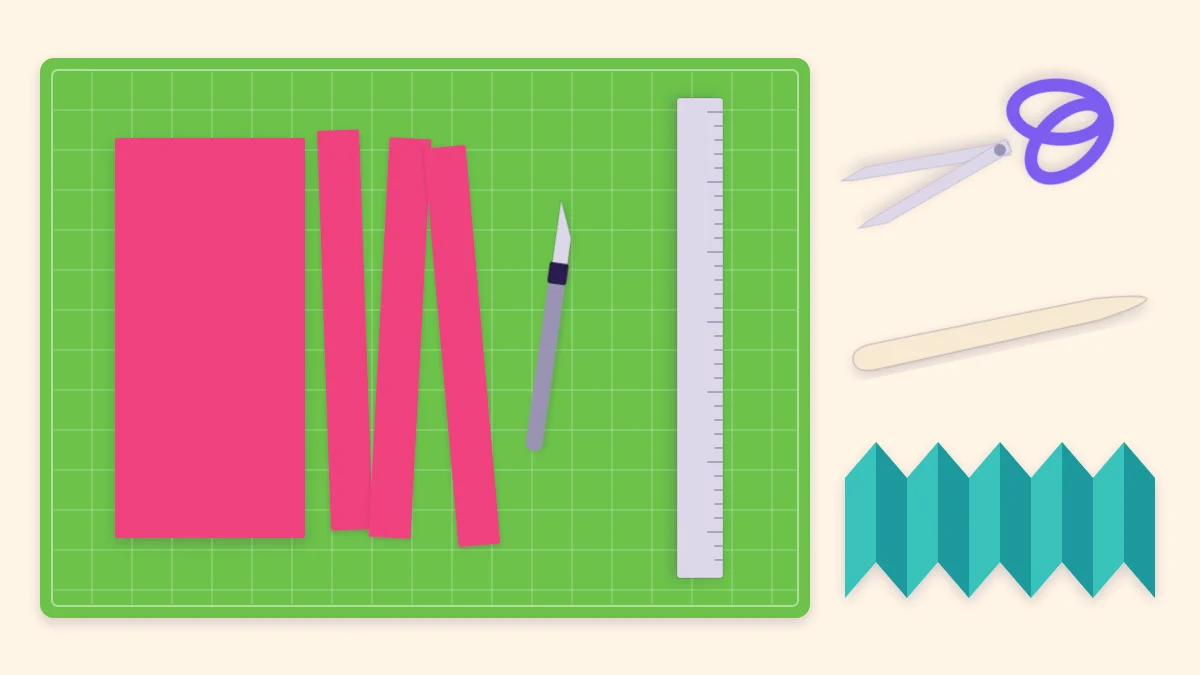
For long, dead-straight cuts, a craft knife against a metal ruler on a cutting mat beats scissors. Press the ruler down with fingers spread and kept well back from its edge, hold the knife at a low angle and make two or three light passes instead of one heavy one. Heavy pressure is what makes a blade jump the ruler.
Keep the piece you want under the ruler, so that a slip cuts into the waste. A paper trimmer, if you have one, does the same job.
Safety note
A craft knife is an adult tool. Cut away from the hand holding the ruler, cap or retract the blade when it is put down, and supervise children with scissors.
Which cutting tool for which material
| Material | Best tool | Notes |
|---|---|---|
| Cardstock, shapes and curves | Scissors | Two or three layers at a time |
| Cardstock, long straight strips | Craft knife and metal ruler, or a paper trimmer | Several light passes on a cutting mat |
| Tissue paper | Sharp scissors | Cut in a clipped stack; single sheets snag |
| Crepe paper streamer | Scissors | Do not pull while cutting, or it stretches |
| Poster board | Scissors or craft knife | Support the whole sheet so it does not crease |
| Corrugated cardboard | Craft knife (adult), or heavy scissors for thin board | Many light passes; never force the blade |
Make your own templates
Any shape you will cut more than twice deserves a template. Draw it once on the plain side of an empty cereal box, cut it out carefully and trace around it with a sharp pencil. Cereal-box card is stiff enough to trace against and thin enough to cut with scissors.
For symmetrical shapes such as hearts and crowns, fold a sheet of paper in half, draw half the shape against the fold and cut through both layers. Cut just inside your traced lines so that no pencil shows on the finished piece.
Score before you fold
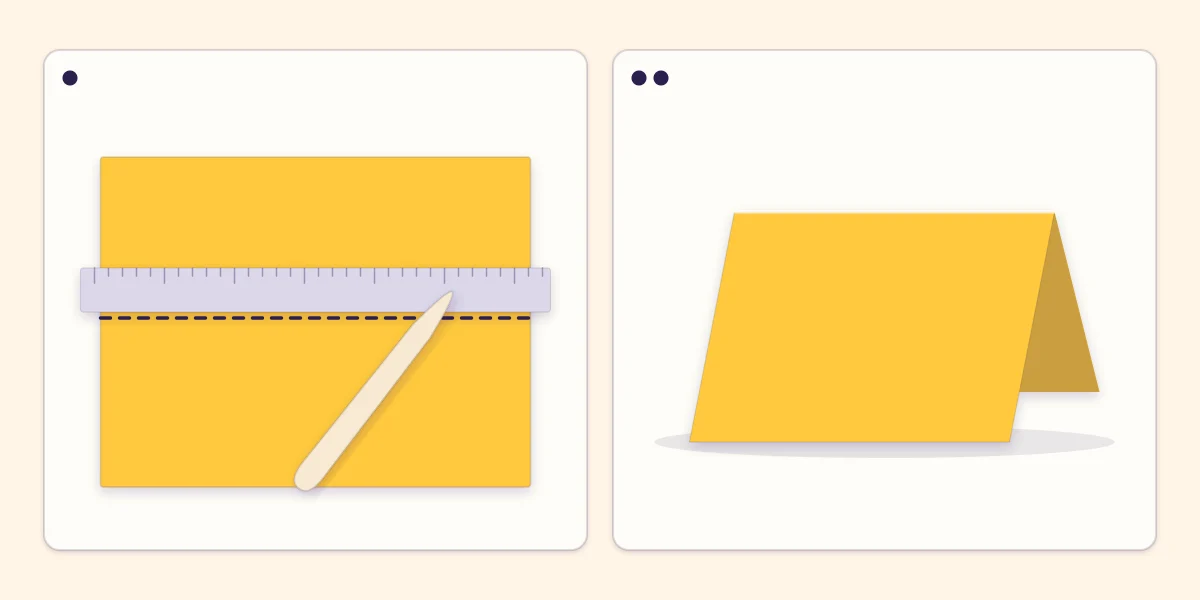
Cardstock folded without preparation bends where it likes, and the surface often cracks along the outside of the fold. A score is a dent pressed into the paper along the fold line. It compresses the fibers in a narrow channel, so the sheet has one weak line and folds exactly there.
You need a blunt point: a bone folder, an empty ballpoint pen or the back of a butter knife. Lay a ruler along the fold line, hold it firmly and draw the tool along its edge with steady pressure. The line should be a visible groove, not a cut. Then fold along the groove and press the fold flat with the side of the bone folder.
Curved scores work the same way against a round lid, which is how the ends of cardstock pillow favor boxes are shaped.
Mountain, valley and accordion folds
A valley fold brings the two sides up toward you, leaving the crease at the bottom of a V. A mountain fold does the opposite, with the crease as a ridge on top. An accordion fold is simply the two alternating at even intervals, and it is the basis of fans, pom-poms and paper rosettes.
Evenness matters more than the exact width. Two reliable ways to get it:
- Mark and score. Tick off the fold width along both long edges of the strip, score between each pair of marks, then fold back and forth along the scores. Best for cardstock.
- Fold in halves. Fold the strip in half, then in half again, and again. Unfold and reverse every other crease. Best for thin paper, and no ruler is needed.
Paper also has a grain, the direction in which most of its fibers run, and folds parallel to it are smoother. Bend the sheet gently both ways without creasing; it bends more easily along the grain.

Fixing rough edges and cracked folds
- Fuzzy or stepped edges: trim a hair’s width off with one long scissor stroke, or smooth cardstock lightly with a nail file.
- A cracked fold: the score was too shallow or the fold runs against the grain. Score more firmly next time; for this piece, color the crack with a matching pencil or cover it with a strip of paper.
- A crooked fold: flatten it, re-score on the correct line and fold again. The old crease will show, so put it on the back.
Once the pieces are cut and folded, something has to hold them together. The guide to glue and tape for party crafts matches each adhesive to the materials it suits.
Frequently asked questions
What can be used instead of a bone folder to score paper?
An empty ballpoint pen or the back of a butter knife both work. Anything with a blunt, smooth point that dents the paper without cutting it will make a usable score when drawn along a ruler.
Why does cardstock crack when it is folded?
The fibers on the outside of the fold are stretched and break, usually because the line was not scored or the fold runs across the paper's grain. Score firmly first, and test the fold direction on an offcut.
How many sheets of paper can be cut at once?
With ordinary scissors, two or three sheets of cardstock or up to about eight sheets of tissue, clipped together outside the cutting line. Thicker stacks shift as you cut, so the lower pieces come out a different size.