DIY Birthday Pennant Banner From Paper
Draw a 5 x 7 in triangle template, nest the pennants to save paper and string them on twine with a fold-over flap or two punched holes.

Tutorial at a glance
Materials
- 4 sheets of cardstock, about 65 lb (176 gsm), in different colors
- Cereal-box card for the template
- 8 ft (2.4 m) of twine, string or narrow ribbon
- Glue stick or double-sided tape
- Contrasting paper for cut letters (optional)
Twelve paper triangles and a length of twine make a DIY birthday pennant banner about 6 ft (1.8 m) long, enough to span a doorway, a mantel or the wall behind the table. It is the project most other party decorations are built around, and the only real decisions are how to attach the pennants to the string and what order to put the colors in.
Everything starts with one triangle template that you draw yourself. Cut it once from stiff card and every pennant after that takes a few seconds to trace.
What you need
- Cardstock, about 65 lb (176 gsm), four sheets of US letter size (8.5 x 11 in, 21.6 x 27.9 cm) in different colors
- A piece of cereal-box card for the template
- Twine or string for folded pennants, or ribbon about 1/4 in (6 mm) wide for punched ones, 8 ft (2.4 m) to allow for tying
- Pencil, ruler and scissors
- Glue stick or double-sided tape, or a hole punch
- A bone folder or empty ballpoint pen for scoring
Draw the template and nest the triangles
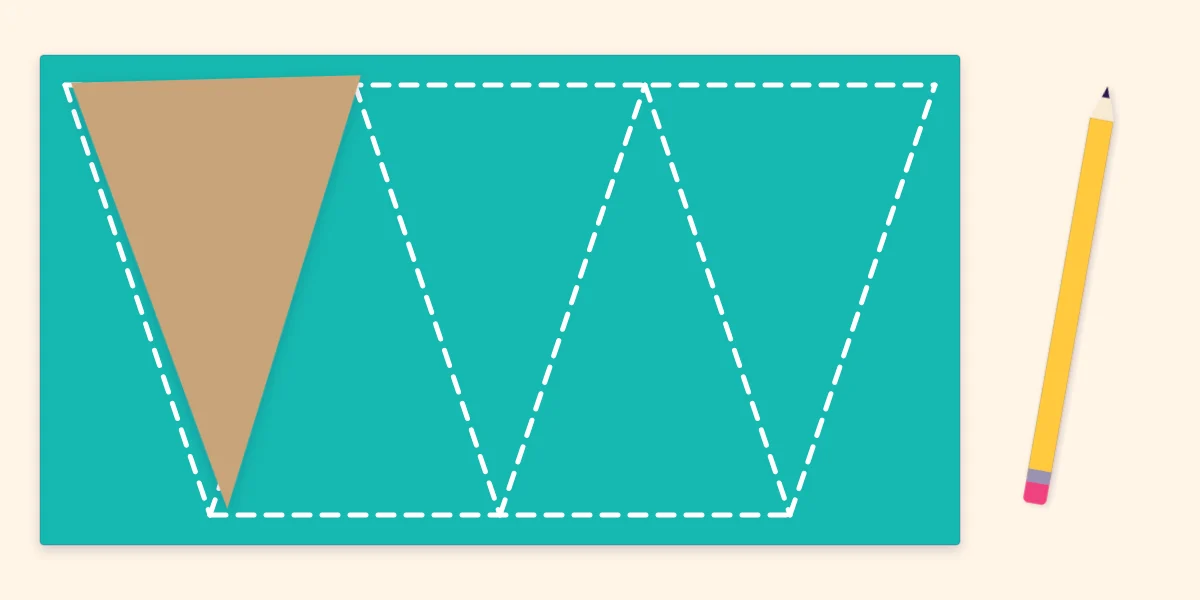
The standard pennant is a triangle 5 in wide and 7 in tall (12.7 x 17.8 cm). To draw it, rule a 5 in line on the card, mark its midpoint at 2.5 in, measure 7 in straight down from that mark and join the point to both ends of the line. Cut it out with care, because every wobble in the template is copied onto every pennant.
Tracing triangles side by side wastes nearly half the sheet. Nest them head to tail instead: trace the first with its point down, flip the template so its point is up and its slanted edge sits on the line you just drew, and continue across. Each new triangle shares an edge with the last one, so one cut frees two pennants. With the sheet turned sideways, three full-size triangles fit in one row, and a smaller pennant 3 in (7.5 cm) wide fits five.
If you plan to use the fold-over flap described below, make the template 8 in (20 cm) tall with a 1 in (2.5 cm) rectangular strip above the wide edge, and trace the pennants in a row all pointing the same way, since the flap prevents nesting.
Two ways to attach pennants to the string
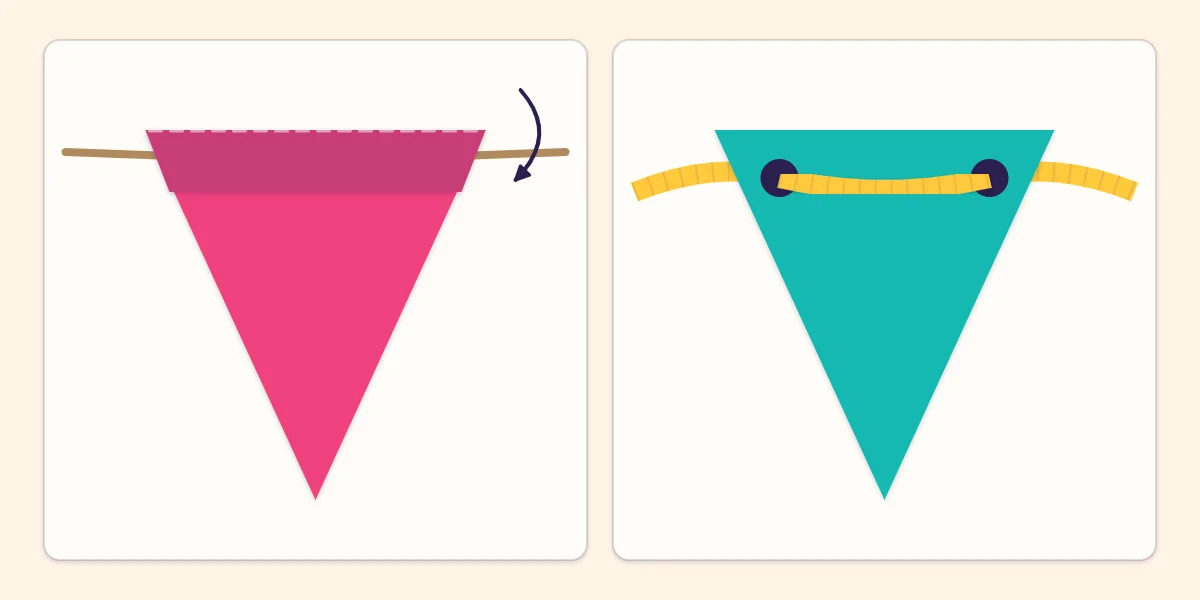
Fold-over flap. Score a line across the pennant 1 in (2.5 cm) below the top edge and fold the flap toward the back. Lay the twine in the crease, run glue stick or double-sided tape along the flap only, and press it down. Keep the adhesive off the twine. A pennant glued this way can slide along the string, so spacing can be changed after the banner is hung.
Punched holes. Punch one hole near each top corner, about 1/2 in (12 mm) in from the edges. Thread the ribbon down through the first hole and up through the second, so it runs behind the pennant. There is no glue and nothing to dry, and the pennants come off flat for storage.
| Fold-over flap | Punched holes | |
|---|---|---|
| Best cord | Twine or string | Flat ribbon |
| Respacing | Slides easily | Slides, but holds less firmly |
| Front view | Clean, no cord showing | Clean between the holes |
| Weak point | Glue on the twine locks the pennant | Holes too near the edge tear out |
How many pennants and how to space them
About 12 standard pennants make a 6 ft (1.8 m) banner, with a gap of roughly 1 in (2.5 cm) between neighbors. For any other span, measure the wall, add about 10 percent for the swag, and divide by 6 in (15 cm) per pennant.
Leave at least 12 in (30 cm) of bare cord at each end for tying. Running short there is the most common planning mistake, and it cannot be fixed without restringing.
Color order, shapes and letters
Lay all the pennants in a row on the floor before stringing. A repeating sequence of three or four colors is the most reliable order. Alternating two colors is bolder, and a gradual shift from light to dark suits a single-color scheme.
Two easy variations use the same template. For a swallowtail, start from a rectangle 5 x 7 in and cut a V notch about 2 in (5 cm) deep into the bottom edge. For a scallop, trace the bottom of the rectangle around a small plate. Round shapes strung on thread make a different decoration altogether, covered in the paper circle garland tutorial.
To spell a name or a greeting, use one letter per pennant and add a blank pennant between words. Draw each letter as a plain block capital about 3 in (7.5 cm) tall on contrasting paper, cut it out and glue it in the upper half of the triangle, where the pennant is widest. Count the letters first and cut that many pennants plus two blanks for the ends. Glue letters on before stringing, while the pennants lie flat.
Tip
For a banner that will be used again, trim the same template from felt; the reusable felt birthday garland explains how to cut and string it.
Hang it with a gentle swag
Fix one end, let the banner dip about 6-8 in (15-20 cm) at the center of a 6 ft span, then fix the other. A banner pulled tight looks stiff and puts all the strain on the fixings; too deep a swag makes the end pennants tilt toward the middle. Use a removable hanging method, test it on a hidden spot first, and keep paper banners away from candles and other heat sources. The room-planning guide to handmade birthday decorations shows where a banner works best on a focal wall.
Troubleshooting
- Pennants flip backward. This happens when the cord passes through one central point. Two holes, or a full-width flap, hold the top edge level. On a punched banner, check that the ribbon runs behind each pennant, not in front.
- The twine sags in the middle. A long banner needs a third fixing point at the center. Thin cotton string also stretches; pull it firmly before measuring.
- Flags curl at the tip. Thin paper curls in humid air or after being rolled. Press the pennants under a heavy book overnight, or switch to cardstock.
Frequently asked questions
How many pennants do you need for a banner?
About 12 pennants of the standard 5 in (12.7 cm) width make a 6 ft (1.8 m) banner with small gaps between them. For another length, measure the span, add about 10 percent for the swag and allow roughly 6 in (15 cm) per pennant.
What size should a pennant banner triangle be?
A triangle about 5 in wide and 7 in tall (12.7 x 17.8 cm) reads well across a room, and three fit in a row on one sheet of letter cardstock when nested head to tail. Make them about half that size for a banner on a shelf or a table front.
How do you put a name on a pennant banner without a printable?
Use one letter per pennant. Draw each letter as a plain block capital on contrasting paper, cut it out and glue it in the wide upper half of the triangle before stringing. Add a blank pennant between words and one at each end.